

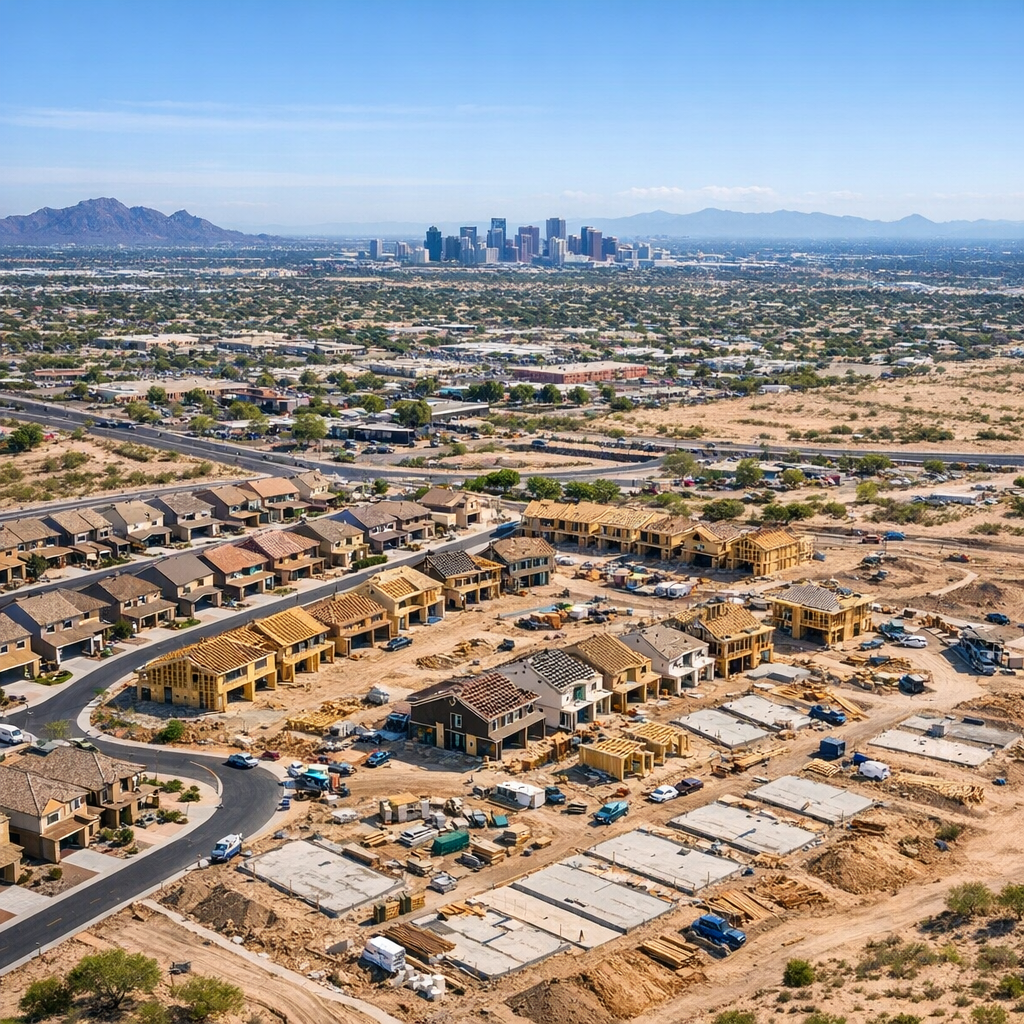
Phoenix’s housing market is experiencing notable shifts, influenced by various factors including economic developments, housing shortages, and new construction projects.
Current Market Trends
As of early 2026, the Phoenix housing market has seen a slight decrease in home prices. According to Redfin, the median sale price of a home in Phoenix was $461,000, down 2.3% compared to the previous year. Homes are selling after an average of 62 days on the market, indicating a moderately competitive market. Zillow reports a similar trend, with the average home value at $410,169, reflecting a 2.7% decrease over the past year. These figures suggest a cooling market, providing potential opportunities for buyers.
Addressing Housing Shortages
Despite the dip in home prices, Arizona faces a significant housing shortage. A report by the Common Sense Institute highlights an immediate need for approximately 56,000 housing units and a long-term deficit of around 110,000 homes. This shortage is driven by high housing prices, elevated interest rates, and supply constraints, making it increasingly difficult for individuals to find suitable housing.
New Developments and Affordable Housing Initiatives
In response to the housing shortage, several development projects are underway. The City of Phoenix recently broke ground on The Moreland, a 237-unit affordable housing community in downtown. This project aims to provide much-needed affordable and workforce housing, with completion anticipated in two phases by December 2027. Additionally, the Girasol Apartments project in the Edison-Eastlake Community is set to replace outdated public housing units with 364 new affordable and market-rate apartments, with construction phases scheduled through 2027.
In Buckeye, the Teravalis development has launched, projected to eventually house up to 300,000 residents in 100,000 homes. This master-planned community addresses the growing housing demand in one of America’s fastest-growing cities.
Conclusion
Phoenix’s housing market is in a state of transition, with decreasing home prices and ongoing efforts to address housing shortages through new developments. These initiatives aim to provide more affordable housing options and accommodate the city’s growing population, reflecting a dynamic and evolving housing landscape.